
Short answer: rate yourself out of 10 on two things - how well you understand KiwiSaver, and how likely you are to act on what you learn. Most New Zealanders land between 2 and 4 on both. The distance between those two scores is usually where the money is quietly going.
Key points:
- Plotting the two scores gives four quadrants. The goal is the top right: you understand your KiwiSaver, you have made informed choices, and you review them.
- High action with low knowledge carries its own risk. It is how people end up switching to a conservative fund during a dip and locking the loss in.
- Good knowledge with low action is the most frustrating quadrant, because the gap between knowing and doing costs real money.
- A free 30 to 40 minute session covers what fund you are in, what your contributions are building towards, whether you are missing government contributions, how your provider compares in the same risk category, and one clear next action.
- About 95% of people leave a session with both more knowledge and a plan to act on it.
Worth checking:
- Which quadrant you are actually in, rather than the one you would like to be in.
- Whether the thing holding you back is a reason to wait or a reason to delay. A job change is an ideal time to review, not a reason to postpone one.
- How long you have been meaning to look at it. Compounding is time-sensitive, so the same improvement made today is worth more than the same one made in five years.
I want you to do a quick self-assessment. On a scale of 1 to 10, rate yourself on two things:
- How well do you understand KiwiSaver? (1 = no idea, 10 = completely across it)
- How likely are you to act on new KiwiSaver knowledge? (1 = unlikely, 10 = very likely)
If you want an objective starting point, the free KiwiSaver Knowledge Challenge gives you a score in a few minutes.
Got your scores? Here's what I find when I ask this question to the people I work with.
Where most people land
The majority of New Zealanders score somewhere between 2 and 4 on both scales. That's not a criticism - KiwiSaver is genuinely confusing, and most of us were never taught how it works. But it does mean there's a significant gap between where people are and where they could be.
If you map those two scales onto a grid, you get four quadrants:
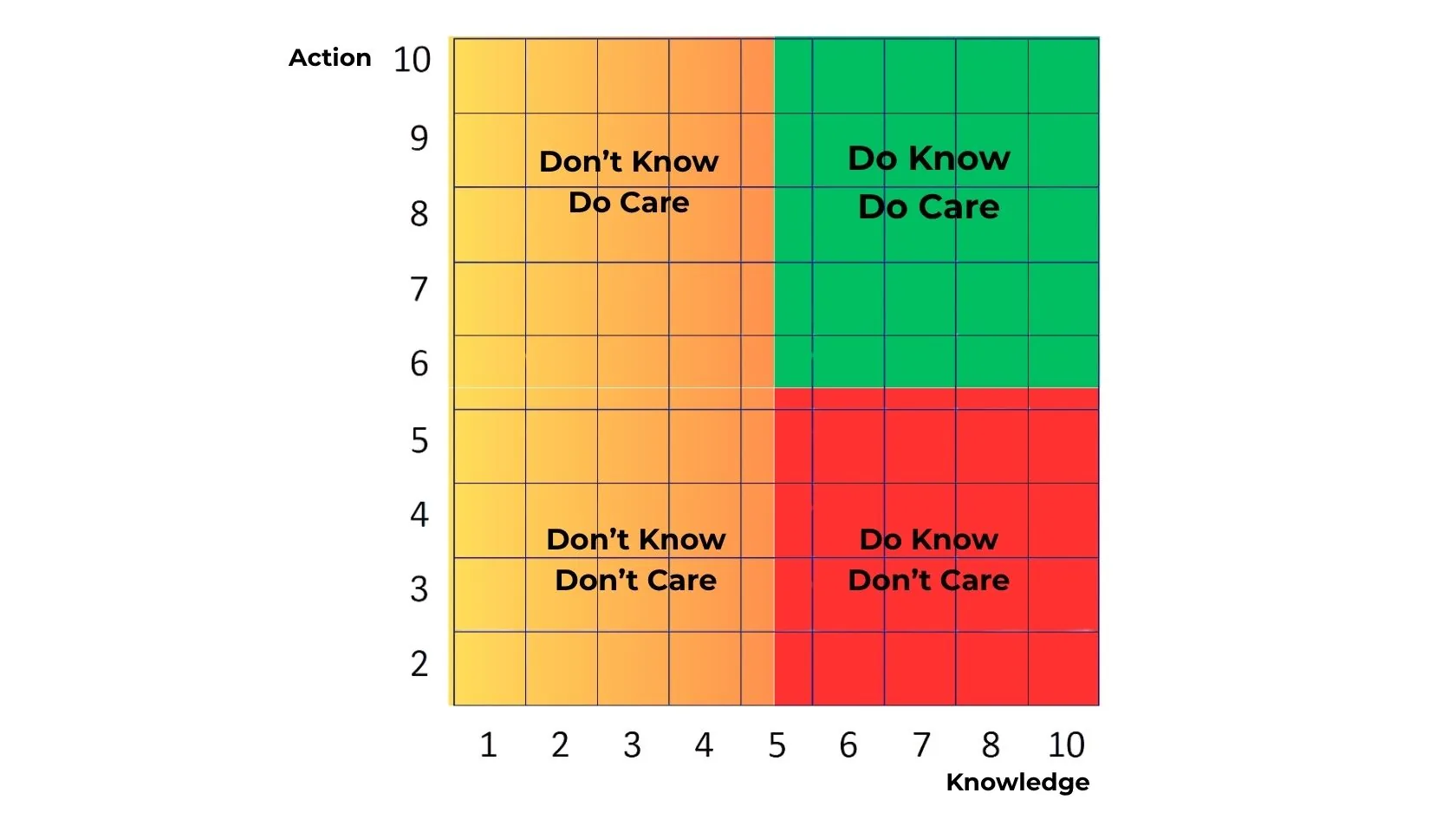
- Bottom-left (low knowledge, low action): You're not sure what fund you're in or what it costs, and you haven't done anything about it. You're not alone - this is the most common starting point.
- Top-left (high action, low knowledge): You've made changes to your KiwiSaver, but without fully understanding what you were doing. This can lead to decisions like switching to a conservative fund during a market dip and locking in losses.
- Bottom-right (good knowledge, low action): You understand the theory but haven't pulled the trigger. Maybe you've been meaning to get around to it. This is actually the most frustrating quadrant to be in, because the gap between knowing and doing is costing you real money.
- Top-right (high knowledge, high action): You understand your KiwiSaver, you've made informed choices, and you review it regularly. This is the goal.
What a free session actually does
I run free 30 to 40-minute KiwiSaver advice sessions with New Zealanders every week. The goal of every session is to move people from wherever they are in that grid to the top-right quadrant.
In that time, I can help most people:
- Understand what fund they're in and whether it suits their situation
- See what their current contributions are actually building toward
- Identify whether they're missing out on government contributions
- Compare their provider against alternatives in the same risk category
- Decide on a clear next action - whether that's staying put or making a change
About 95% of the people who come through a session leave with both more knowledge and a concrete plan to act on. The confidence that comes from having clear, personalised information makes a real difference.
The 5% who don't act - and why
The remaining 5% leave the session with new knowledge but still don't act. The reasons I hear most often:
- "I want to wait until after the election."
- "I'm changing jobs soon, so I'll sort it then."
- "My balance isn't big enough yet to be worth worrying about."
- "I'll get to it when things settle down."
I understand all of these. But they're almost always reasons to delay, not genuine reasons to wait. Elections don't reset KiwiSaver rules overnight. Job changes are actually an ideal time to review - not a reason to put it off. And the smaller your balance, the more impact a good fund choice has as a percentage of future growth.
The best time to sort your KiwiSaver was years ago. The second-best time is now.
Where do you sit?
Go back to your two scores. If you're not already in the top-right quadrant, the gap between where you are and where you could be is real - and it's measurable in dollars.
A free session costs you nothing. There's no obligation to make any change. But for most people, it's the thing that finally moves them from "I should probably look at that" to "I'm glad I did."
Sources and further reading
Primary New Zealand sources for the points above. Rules change, so check the current position before acting:
- Inland Revenue - how KiwiSaver works - the basics worth knowing before you act.
- Inland Revenue - government contribution - one of the most commonly missed entitlements.
- Sorted KiwiSaver fund finder - check your own fund independently.
- Sorted - which KiwiSaver fund suits you - turn understanding into a decision.
Book your free session
30-40 minutes, no obligation, no cost. Online anywhere in NZ or in person across Canterbury.
Book a free sessionNo. Even with 15-20 years to retirement, optimising your fund and contributions now can make a significant difference. Compound growth still works in your favour, and there's often a lot of low-hanging fruit - wrong fund type, undercontributing, missing government credits, or being with a provider that consistently underperforms.
