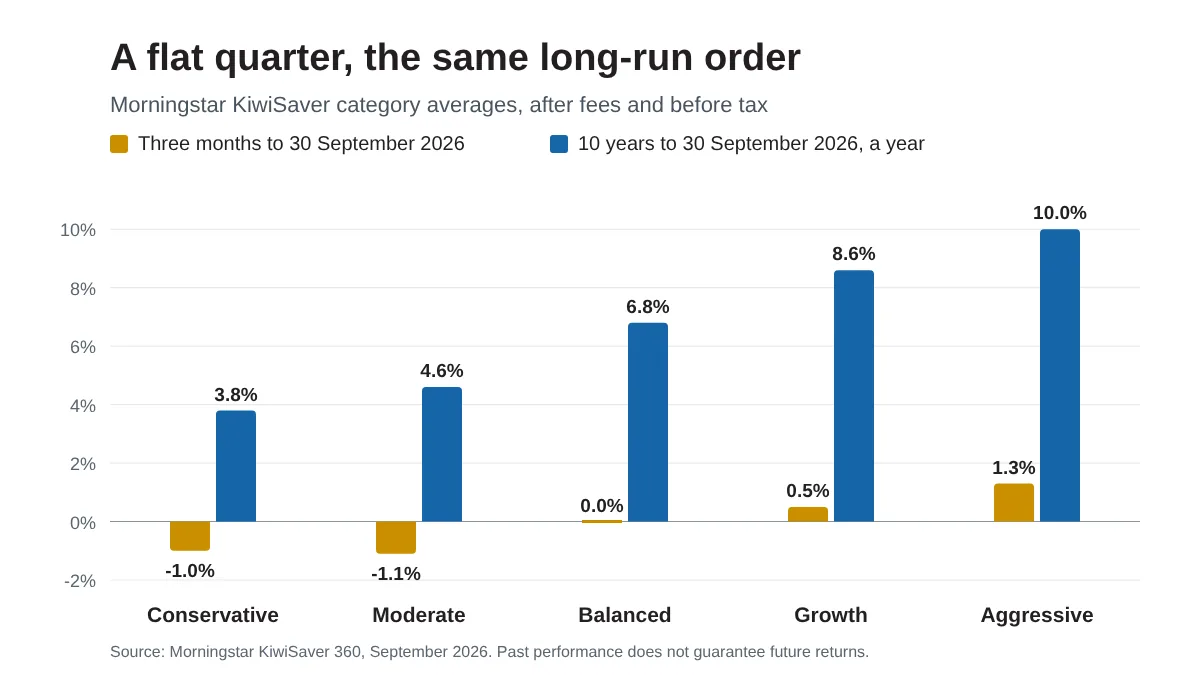
Short answer: for the three months to 30 September 2026, most KiwiSaver funds went more or less nowhere. Morningstar's category averages ran from -1.1% for moderate funds to 1.3% for aggressive funds, and the average balanced fund finished almost exactly where it started. KiwiSaver still passed $150 billion, mostly because members kept contributing.
Key points: rising bond yields pulled the conservative end slightly backwards while shares nudged the growth end slightly ahead. Over 10 years the order is unchanged: aggressive 10.0% a year, growth 8.6%, balanced 6.8%, moderate 4.6% and conservative 3.8%, after fees and before tax.
Worth checking: whether your fund's risk level still matches when you need the money, how your fund compares with others in the same category over five and ten years, and what you are paying in fees. One flat quarter is not a reason to switch, in either direction.
Morningstar published its KiwiSaver report for the September 2026 quarter on 29 October. Every quarter I read it cover to cover and update the figures on this site, and every quarter I am struck by how different the story looks depending on which column you read.
This quarter is a good example. If you only looked at the three-month column, you would think nothing happened. If you looked at the ten-year column, you would see exactly what you would expect. Both are true, and the gap between them is the most useful thing in the whole report.
The quarter in one line: treading water
Morningstar's own headline was that quarterly returns "tread water", and that is a fair summary. Here are the category averages for the quarter, alongside the longer periods:
| Category | 3 months | 1 year | 3 years | 5 years | 10 years |
|---|---|---|---|---|---|
| Conservative | -1.0% | 1.9% | 6.4% | 3.0% | 3.8% |
| Moderate | -1.1% | 2.8% | 7.7% | 3.4% | 4.6% |
| Balanced | 0.0% | 6.5% | 11.2% | 5.6% | 6.8% |
| Growth | 0.5% | 7.9% | 12.7% | 6.2% | 8.6% |
| Aggressive | 1.3% | 11.7% | 16.1% | 8.4% | 10.0% |
Scroll the table sideways to see every column.
For context, the quarter before this one, to 30 June, was a cracker: conservative funds averaged 3.3% and aggressive funds 11.9% in just three months. Plenty of people looked at their balance in July and felt very good about life. This quarter gave a little of that back at the cautious end and added a little at the adventurous end. Neither quarter, on its own, tells you much about the fund you are in.
Why the cautious funds went backwards
This is the part that surprises people, so it is worth a minute. Conservative and moderate funds hold a lot of bonds and other fixed interest. Most people think of those as the safe part of a portfolio, and over long periods they are the steadier part. But they are not immune to falling in value.
When interest rates are expected to stay higher for longer, the price of existing bonds falls. That is what happened this quarter. Renewed tension in the Middle East pushed oil prices up, which revived worries that inflation would hang around, and central banks signalled they were in no hurry to cut rates. Bond yields rose around the world, and bond prices fell.
Shares, on the other hand, kept climbing overseas. Morningstar points to solid company earnings and continued spending on artificial intelligence, led by the United States. In New Zealand-dollar terms international shares were still positive, though the gains were smaller than in the June quarter. New Zealand shares were mixed, and Australian shares did better than ours.
Put those together and you get exactly the pattern in the table. The more bonds a fund holds, the more the quarter hurt. The more shares it holds, the more it helped. Nobody did anything wrong. Their funds simply did the job they were built for.
Default funds: a flat quarter, a decent year
If you have never chosen a fund, there is a good chance you are in a default fund. Morningstar says the default funds averaged 0% for the quarter but 7.4% over the past year, after fees. The Simplicity default fund had the strongest quarter at 0.8%, and over three years Simplicity's and Fisher Funds' default funds were level at 12.3% a year.
Defaults are balanced funds now, which is a big improvement on the old conservative defaults. But a default fund is designed for everyone, which means it is designed for no one in particular. If you are 25 and will not touch your KiwiSaver for 40 years, or 60 and about to start drawing on it, it is worth checking whether a default is still the right fit. I explain how the defaults work in my guide to default KiwiSaver funds.
Who stood out over five and ten years
I always look past the quarter to the longer periods, because that is where a manager's decisions actually show. These were the funds Morningstar ranked first in each category:
| Category | Over 5 years | Over 10 years |
|---|---|---|
| Conservative | QuayStreet, 4.4% | QuayStreet, 4.6% |
| Moderate | Generate, 5.0% | MAS, 5.5% |
| Balanced | QuayStreet, 8.6% | QuayStreet, 8.1% |
| Growth | QuayStreet, 10.5% | Simplicity, 9.9% |
| Aggressive | SBS Wealth, 9.9% | Generate, 10.7% |
Scroll the table sideways to see every column.
QuayStreet also had a strong quarter: its growth fund led the growth category with 2.7%, and its balanced and socially responsible funds took the top two spots in the balanced category. Two things are worth saying about that table, though.
First, the gaps at the top are often tiny. In the aggressive category over ten years, Generate's Focused Growth Fund and Booster's Socially Responsible High Growth Fund both show 10.7%, and Morningstar ranks Generate first on the unrounded figure. Choosing between two funds on a difference you cannot see at one decimal place is not a strategy.
Second, in the interest of being upfront: some of the names in that table are on my implementation panel and some are not. I am showing it because it is what Morningstar reported, not as a list of recommendations. The right fund for you depends on your timeframe and how you would feel watching your balance fall, not on who topped a table.
The quarter's most useful lesson came from one fund
Morningstar lists the extremes every quarter, and this one had a beauty. The highest three-month return of any KiwiSaver fund was Kōura Wealth's Bitcoin Fund at 42.6%. The lowest return of any fund over the past 12 months was also the Kōura Bitcoin Fund, at -25.1%.
Same fund, best quarter and worst year, in the same report. That is not a criticism of the fund: it does exactly what it says, and people choose it knowing it is volatile. But it is the clearest illustration I have seen of why a single quarter tells you so little. At the other end, the lowest three-month return was Kōura's Clean Energy Fund at -20.5%, and the highest 12-month return was the Australian Resources Fund in the Smart KiwiSaver scheme (formerly SuperLife) at 43.3%. Specialist single-sector funds can swing hard in both directions.
If you want to see how much a risk level can move, my article on the role of risk in your KiwiSaver choices walks through it.
KiwiSaver is now a $150 billion scheme
Despite the flat returns, total KiwiSaver assets in Morningstar's database rose by about $2 billion over the quarter to just over $150 billion, the first time they have passed that mark. With returns close to zero, most of that growth came from contributions. That is quietly encouraging: the money going in every payday is doing the heavy lifting while markets take a breather.
A few other numbers from the report:
- ANZ is still the largest provider with 15.9% of the market and $23.8 billion, though Morningstar notes it has been losing market share for five years. ASB is second on 14.7%, followed by Fisher Funds, Milford and Westpac.
- The five largest providers hold about 62.7% of all KiwiSaver money, around $94.2 billion.
One change to the report
If you followed the sustainability ratings in earlier reports, Morningstar has removed its Globe Sustainability Rating from the tables this quarter. The column now says a Morningstar Medalist Rating is "coming soon". I have taken the sustainability marks off my KiwiSaver fund directory to match, rather than keep showing ratings from an old report. If responsible investing matters to you, my guide to what responsible investment really means is still a good starting point.
What I would do with these numbers
Not much, in most cases, and that is the point. A flat quarter is a good moment to check a few things calmly, rather than a reason to make changes in a hurry:
- Check your risk level against your timeframe. If you need the money for a first home in the next year or two, a conservative or moderate fund dipping 1% is the trade-off for not being exposed to a 20% fall in shares. If you are decades from 65, a growth or aggressive fund is built for exactly this kind of noise.
- Compare like with like. Put your fund next to others in the same category over five and ten years. Comparing a conservative fund with an aggressive one tells you nothing about either.
- Look at the fees behind the returns. They are already taken out of Morningstar's figures, but it is worth knowing what you are paying and what you are getting for it.
- Do not chase last quarter's winner. The fund at the top of the three-month column is usually the one that took the most of whatever risk happened to pay off.
You can compare any fund against its category average on my KiwiSaver returns comparison, which now uses the September figures, and look up every open fund's returns, fees and size in the fund directory.
My honest take
Quarters like this one are boring, and boring is underrated. Markets do not go up in a straight line. Some quarters give you 10%, some give you nothing, and some take a bit back. What matters is that your fund suits the job you need it to do, that you are not paying more than you need to, and that you keep contributing through all of it.
The people who do well with KiwiSaver are rarely the ones who picked the top fund of the quarter. They are the ones who picked a sensible fund for their timeframe, checked it every year or so, and left it alone in between.
If you would like a second pair of eyes on your fund, sessions with me are free and there is no obligation to act on anything.
Simple Steps. Solid Results.
This article is general information only and is not personalised financial advice. All returns are from the Morningstar KiwiSaver 360 report for the quarter ending 30 September 2026, after fees and before tax. Past performance does not guarantee future returns.
Sources and further reading
- Morningstar - KiwiSaver 360 report - the September 2026 quarter, published 29 October 2026. The source of every return, ranking and market share figure above.
- Disclose Register - every scheme's quarterly fund update, with each fund's own returns and fees.
- Sorted - KiwiSaver fund finder - a government-backed tool for comparing funds and fees.
- Compare funds side by side on my KiwiSaver returns comparison, or browse every scheme on the KiwiSaver providers page.
Not sure your fund still fits?
A free 30-40 minute session with Cam. No obligation. Online anywhere in NZ or in person across Canterbury.
Book a free session