
Short answer: a passive fund buys the whole market and tries to match it as cheaply as possible. An active fund pays a team to decide what to hold and when to change it. Passive does its best work when markets are grinding upwards. My view is that a good active manager earns their keep in the messy years rather than the easy ones, and that the word "good" is doing an enormous amount of work in that sentence.
Key points:
- Style is not the same thing as risk level. Whether you are in a conservative or a growth fund decides far more of your outcome than passive or active does.
- Fees are the one number you know in advance. Across the ten schemes on my implementation panel, annual fund charges run from 0.20% at the index-tracking end to 1.38% at the active end.
- Comparing headline fee ranges between schemes is close to useless. The bottom of almost every range is a cash fund. Compare the fund you would actually be in against the fund you are actually in.
- Passive does not automatically mean diversified. An index fund holds whatever the index holds, in whatever proportions it holds it, so when a handful of very large companies come to dominate an index, the fund tracking it is concentrated in them too.
- KiwiSaver returns are published net, after the fund's annual charges have already been taken out. Compare net returns and then subtract the fees again and you are counting them twice. The fee is the price; the net return is what you got for it.
- A fee tells you what you pay. It tells you nothing about what you get. The honest test of an active manager is how the fund actually behaved when markets fell, not how it reads in a brochure.
- You do not have to pick a side. Plenty of sensible KiwiSaver setups hold both.
Worth checking:
- Your own fund's product disclosure statement for its current annual fund charge, its risk indicator and its target investment mix. Fees move, and a summary written on one date goes stale.
- The Morningstar returns page on this site, which covers every scheme rather than the ones I work with. Note that the returns there are already net of the fund's annual charges, which is the point most people miss.
- Past returns are not a guide to future returns. That is not a legal footnote I am obliged to add. It is the single most misused number in this whole debate.
This is one of the two or three questions that comes up in almost every session I run. Someone has read that index funds beat the professionals, or a mate has told them their active fund is a rip-off, or they have seen a fee comparison and got a fright. Then they ask me which one is right.
The honest answer is that it is the wrong question to ask first. But it is a good question to ask second, and it is worth understanding properly, so let me take it apart in plain language.
The one-sentence version of each
Passive
A passive fund tracks an index. An index is just a list of companies put together by a set of rules, like the biggest 50 companies on the New Zealand share market or the largest 500 in the United States. The fund buys everything on the list in roughly the same proportions, then leaves it alone apart from routine rebalancing.
Nobody is sitting in a room deciding that this company looks cheap and that one looks expensive. That is the point. There is very little to pay for, so passive funds are generally cheap, and by design they will deliver close to whatever the market delivers, minus the fee.
Active
An active fund pays an investment team to make calls. What to buy, what to avoid, how much to hold in cash, whether to hedge the currency exposure, when to reduce risk. The Financial Markets Authority puts the distinction simply: active managers make decisions on what to buy and sell, passive funds track an index.
All those decisions cost money, which is why active funds usually charge more. The promise is that the decisions add more than they cost. Sometimes that is true. Often it is not.
Before anything else: style is not the same as risk
This trips up more people than the fees do, so I want to be blunt about it.
Passive or active is a question about how your money is run. Conservative, balanced, growth or aggressive is a question about what your money is invested in, and specifically how much of it sits in growth assets like shares rather than income assets like cash and bonds. That is what the familiar labels are measuring when funds get grouped as defensive, conservative, balanced, growth and aggressive, and your fund's own product disclosure statement sets out its target mix and its risk indicator.
The second question drives most of your result. A passive growth fund and an active growth fund will have far more in common with each other than either has with a conservative fund of the same style. If you are twelve months out from a first-home withdrawal and sitting in an aggressive fund, the passive-or-active debate is not your problem. Your fund type is.
So: get the risk level and the timeframe right first. Then have the style conversation. I have written more about that in the difference between KiwiSaver fund types.
The fees, in real New Zealand numbers
Fees are the one part of this you can know in advance, which is precisely why they get so much attention. Here is what the ten schemes on my implementation panel actually charge. I compare providers and funds across the wider New Zealand market, so this table is not the market, but it does cover both ends of the style range.
Scroll the table sideways to see every column.
| Scheme | Investment style | Annual fund charge |
|---|---|---|
| Smart KiwiSaver | Index-tracking | 0.20% to 0.70%Default Fund 0.20%. Diversified funds 0.56% to 0.63%. |
| Kernel Wealth | Index-tracking | 0.25% to 0.45%Most funds 0.25%. |
| Kōura Wealth | Predominantly passive | 0.63% to 1.10%Pre-set strategies 0.75% to 1.03%. |
| Booster | Active, alongside lower-cost index-based funds | 0.35% to 1.34%Geared Growth 1.74%. |
| Fisher Funds | Active | 0.37% to 1.23% |
| Generate | Active | 0.40% to 1.25% |
| Milford | Active | 0.20% to 1.25%Some funds include an estimated performance fee. |
| SBS Wealth | Active | 0.45% to 1.20% |
| QuayStreet | Active | 0.74% to 1.38% |
| Pathfinder | Active, built around an ethical mandate | 1.20% to 1.35% |
Three things jump out of that table, and none of them is the one people expect.
The gap is real but it is not a chasm. The cheapest index option on the panel is 0.20% and the dearest active fund is 1.38%. On a $60,000 balance that is roughly $120 a year against roughly $828 a year. Over thirty years, with compounding, the difference is not small. Fees are a genuine headwind and anyone who waves them away is selling you something.
But comparing those ranges scheme against scheme tells you almost nothing. The bottom of nearly every range is a cash fund, which needs very little managing whoever runs it, and the top is an aggressive or specialist one. So comparing one scheme's floor with another's floor compares two cash funds, and comparing a floor with a ceiling compares a cash fund with an aggressive fund. Neither is the decision you are making. The only comparison that means anything is like for like: the growth fund you would actually be in, against the growth fund you are actually in. The scheme-level label blurs too, because Booster runs active funds alongside lower-cost index-based options and Kernel Wealth's Cash Plus and NZ Bond funds are actively managed inside an otherwise index-tracking range.
Fixed member fees matter more than people think at small balances. A $36 a year member fee on a $2,000 balance is 1.8% before you have paid a cent of fund charge. On a $200,000 balance it rounds to nothing. Same fee, completely different significance, which is why I never quote a single headline number without asking what someone's balance actually is.
The bit that changes how you should read all of this: returns are already after fees
If you take one thing from this article, make it this one. It is the single most common misunderstanding I come across, and it quietly leads people to the wrong fund.
KiwiSaver returns are published net. When you look up a fund's return, that figure is what was left after the fund's annual charges had already been taken out. Precisely: it is the return after the fund's annual fund charges and before your own prescribed investor rate tax. The fee has already been deducted before the number reaches you.
Which means that if you compare net returns and then also subtract the fees, you are counting the fees twice. I see it constantly. Someone lines up two funds, sees one returned 8% and charges 1.10%, sees the other returned 6% and charges 0.30%, and reasons their way to the cheaper one because "the fees will eat the difference". They will not. They already have. The first fund put 8% in the member's account after being paid. The second put 6% in. The expensive fund won, and it won by two percentage points, and the fee was the price of getting there.
So here is the cleaner way to hold it: the fee is the price, the net return is what you got for it. Judging a fund on its fee alone is like choosing a builder on their hourly rate without looking at the house. The rate is real, it is knowable in advance, and it is entirely the wrong thing to decide on by itself.
Now the discipline that has to come with that, because this argument is very easy to abuse.
A fee is certain and a return is not. That asymmetry is the whole reason fees deserve attention at all. You know today what the charge will be; nobody knows what the fund will return. A higher fee is a guaranteed headwind working against an uncertain benefit, every year, whether the manager earns it or not. Over decades that compounds against you, and it is why the low-cost argument has real force even though the return figures already account for it.
And past net returns are not future net returns. Picking last year's top performer is its own well-documented way to lose money, because you are usually buying something after its good run rather than before it. Look at longer periods, three, five and ten years, compare funds of genuinely similar risk, and treat any single year as close to noise.
Put those together and the sensible question stops being "which is cheaper" and becomes: over a decent stretch of time, and against funds taking similar risk, did this fund deliver more after its fees than the alternative did after its fees? That is a harder question. It is also the only one that pays you.
What each style actually does well
Here is the comparison I use with clients, laid out side by side.
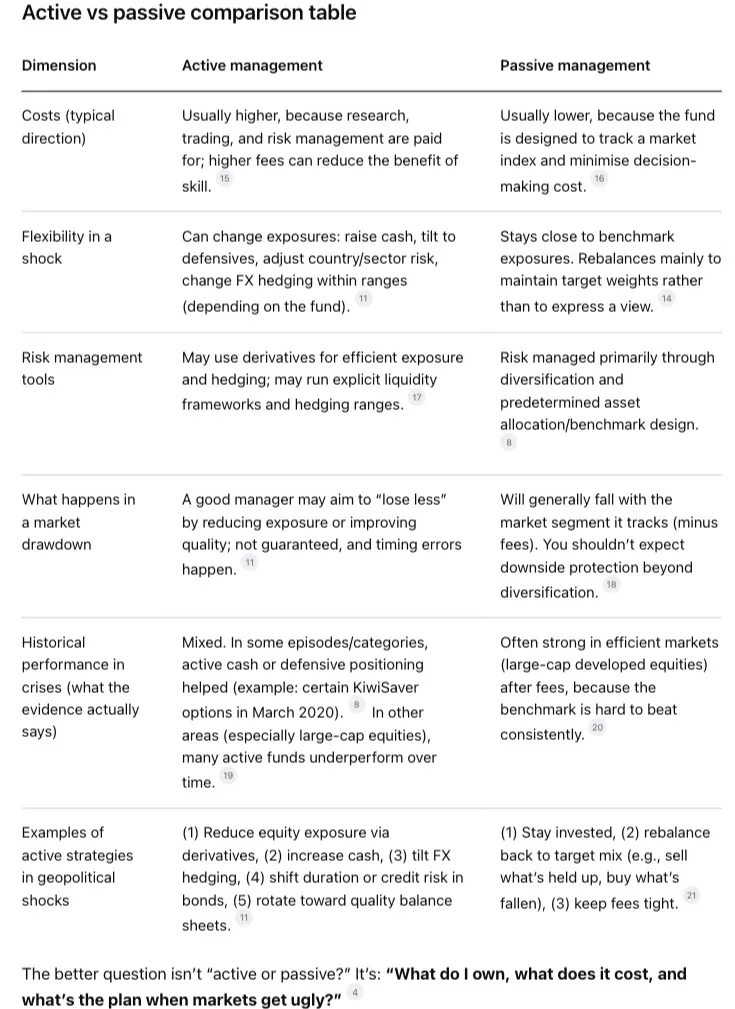
The row I would draw your eye to is the one about drawdowns. A passive fund will generally fall with the market segment it tracks, minus fees, and it is not designed to do anything else. That is not a flaw. It is the contract. An active manager may reduce exposure, raise cash or tighten risk. May. There is no guarantee, and getting the timing wrong is its own risk.
The bit almost nobody checks: how concentrated your passive fund really is
This is the part of the debate that gets least airtime and deserves the most, so I want to spend a moment on it.
"Passive" gets treated as a synonym for "diversified". It is not. An index fund does not choose to be diversified. It holds whatever the index holds, in whatever proportions the index holds it, and most of the big share indices weight their holdings by company size. So the bigger a company gets, the bigger a share of the fund it becomes, automatically, with nobody deciding that this is a sensible amount to own.
Over the past decade that has quietly changed what a plain index fund is. Concentration in the largest United States index has risen sharply, and a handful of very large technology companies now make up a far bigger share of it than they did ten years ago, at levels not seen in decades. Buy the index today and you are buying a great deal more of those few companies than most people assume they are getting when they buy "the whole market".
Which sets up a genuine irony. Someone chooses a passive fund partly to avoid the risk of a manager making a bad call, and ends up with a concentrated position in one part of one sector, arrived at by nobody's decision at all. That is not an argument against index funds. Concentration is also exactly what drove the strong returns of recent years, and you cannot enjoy the upside of a concentrated market and then call it a flaw when the same concentration works the other way. It is an argument for knowing what you actually own.
Here is how to check yours, and it takes about five minutes. Go to your provider's own website and find the latest report or fund page for the fund you are actually in. Most publish their top ten holdings, updated regularly, and that is where you will see the actual company names. Add up what those ten come to as a share of the fund. Then ask yourself whether that is the level of exposure to those particular companies you thought you had. In my experience most people are surprised, and a few are startled.
If your provider does not publish it clearly, that is worth knowing too, and it is a fair thing to ring them about. It is your money and they should be able to tell you what it is invested in.
This is also where the active argument stops being abstract. A manager can decide not to hold that much of one company. An index fund cannot. Whether they use that freedom well is the whole question, but the freedom is real, and it is the clearest thing you are actually buying when you pay an active fee.
My honest take
Now the part you actually came for.
Passive funds work well when the market is going up. When shares are grinding steadily higher, the market return is a good return, and the cheapest way to capture the market return is to buy the market and pay as little as possible for the privilege. In a long bull run, low fees compound quietly in your favour and there is very little a manager can do to add value that the fee does not then take back. If that is the whole of your investing life, passive wins on arithmetic alone.
Good active managers earn their fee in volatility. When markets get ugly, the ability to hold more cash, cut exposure, avoid the wobbliest parts of the market and refuse to be a forced seller is worth something real. A manager who loses less in a bad year has less ground to make up in the recovery, and that asymmetry compounds too. The most credible examples I have seen look boring in hindsight: more cash, less leverage, tighter risk controls, disciplined rebalancing. Not clever bets. And it is worth noticing that the concentration described above is a volatility question as much as a returns one: the more of an index sits in a few names, the more a wobble in those few names is felt by everyone tracking it.
Now the qualifier, because I am not going to sell you a story.
The word "good" is carrying that entire sentence. Independent scorecards, most notably the SPIVA reports published by S&P Dow Jones Indices, consistently find that a large share of active funds underperform their benchmark over long periods, and that the odds get worse as fees rise and as the timeframe lengthens. That finding is robust and I am not going to pretend otherwise. The average active manager does not beat the index. My argument is not with that evidence. It is that the average is not what you are buying: you are buying one specific manager, and the spread between the good ones and the mediocre ones is wide.
Which means the whole thing collapses into a single practical question. Can you identify a good manager in advance, and are you paying a fee that leaves room for their skill to actually reach you?
How I tell a good active manager from an expensive one
If you are paying active fees, you are buying something specific: risk management, security selection, tactical positioning, currency decisions. So ask for the evidence in the places it would show up.
- How did the fund behave in the drawdowns? March 2020 and calendar 2022 are the two most useful stress tests in recent memory. Did the fund fall less than its benchmark, and if so, why? A manager who cannot explain what they did and why is not managing, they are guessing.
- What is the benchmark, and do they use it consistently? A manager who changes the yardstick after a bad year is telling you something.
- Is the fee proportionate to what is actually being done, and does the net return show it? A fund charging active fees to hold something close to the index is the worst of both worlds. You pay for decisions and receive the market. The net return over a decent stretch is where that shows up, because the fee has already been taken out of it.
- Is there a performance fee, and how is it structured? Some funds charge one. Look for a high water mark, so you are not paying twice for the same recovery, and check what the estimated fee actually was in the last reporting year rather than the theoretical maximum.
- How long has the team been there? A track record belongs to the people who produced it. If they have left, so has it.
These are the same value-for-money questions the FMA has pushed the industry to answer more consistently, and any decent provider will have the answers ready. If getting a straight answer is hard work, that is your answer.
You do not have to pick a side
The debate gets framed as a war because a war makes better content. In practice, plenty of sensible KiwiSaver setups hold both, and as the fee section showed, several schemes already blend the two inside a single range.
The usual logic runs like this: use cheap index exposure in the big, heavily researched markets where beating the benchmark consistently is hardest, and pay for active management where a manager has more room to add value or where downside protection matters most to you. That is a defensible position and it is a long way from "index funds always win" or "you get what you pay for".
It does have a tension in it, though, and I would rather name it than tidy it away. The market where the benchmark is hardest to beat is also the one carrying the most concentration right now. So the same argument that says "just buy the index there" is pointing you at the exposure most worth understanding before you buy it. I do not think that settles the question either way. It does mean the honest version of the blend is a decision you make with your eyes open, not a rule of thumb you inherit from a podcast.
What I would actually do
In order, because the order matters more than any single step.
- Check your fund type against your timeframe. When will you use this money? That answer sets your risk level, and your risk level does most of the work. Everything below is a refinement.
- Look up your fund's top ten holdings. Your provider's latest report or the fund's page on their website is where to find them, with the actual company names. Add them up. That one number tells you more about the risk you are carrying than the passive-or-active label ever will.
- Find out what you are actually paying. Not the range for the scheme, the annual fund charge on your fund, plus any fixed member fee, as a dollar figure against your balance. Most people I meet have never seen this number.
- Work out what you are getting for it. Look at the net return over three, five and ten years against funds of similar risk, remembering that those figures are already after the fund's charges. If it is an active fund, look at the drawdown behaviour and the benchmark too. If it is a passive fund, check it is tracking what you think it is tracking and that the fee is competitive for that exposure.
- Decide what you want in a bad year. Some people genuinely sleep better knowing a manager is watching. Others would rather pay less and ride it out. Both are legitimate, and the wrong answer here is the one that makes you panic-sell at the bottom, which costs far more than any fee.
- Then, and only then, consider a change. And change because your situation or your evidence changed, not because the news got loud. I have written about that in when the stock market takes a dive.
If you want the market-wide return data rather than my opinion, the quarterly Morningstar KiwiSaver survey is on this site and it covers every scheme, not just the ones I work with.
The bottom line
Passive is the sensible default and a genuinely good answer for a lot of people. It is cheap, it is transparent, and over a long rising market it is very hard to beat after fees.
But "the average active fund underperforms" and "a good active manager is worth paying for" are both true at once, and only one of them fits on a social media post. My job is to work out which specific fund, run in which specific style, at which specific cost, suits your specific timeframe. That is a slower conversation than picking a team, and it is the one worth having.
Simple Steps. Solid Results.
Frequently asked questions
Is a passive KiwiSaver fund always cheaper than an active one?
Usually yes, when you compare like with like. Index-tracking schemes sit at the cheap end, with Kernel Wealth charging 0.25% a year on most of its funds and the Smart KiwiSaver Default Fund charging 0.20%. But be careful comparing headline ranges between schemes, because the bottom of almost every range is a cash fund, which needs very little managing whoever runs it, and the top is an aggressive or specialist fund. The only comparison that means anything is the fund you would actually be in against the fund you are actually in.
Are KiwiSaver returns shown after fees?
Yes. KiwiSaver returns are published net, meaning after the fund's annual charges have already been deducted, and before your own prescribed investor rate tax. So when you compare two funds' returns, the fees are already reflected in the numbers, and subtracting the fees again double counts them. The fee is the price and the net return is what you got for it. Fees still matter, because a fee is certain while a return is not, but a fund should be judged on both together over three, five and ten years rather than on its fee alone.
Do active KiwiSaver managers beat the market?
Some do and many do not, and the evidence is genuinely mixed. Independent scorecards such as the S&P Dow Jones Indices SPIVA reports consistently find that a large share of active funds underperform their benchmark over long periods, and the odds get worse as fees rise. The case for a good active manager rests mainly on how they handle falling and volatile markets, not on beating a rising one. Judge any active fund on how it actually behaved in past drawdowns.
Should I switch my KiwiSaver from passive to active, or the other way around?
Not on the basis of style alone. Your fund type, meaning how much of the fund sits in growth assets, and your timeframe drive far more of your result than passive versus active does. Sort the risk level and the timeframe first, then decide how you want that mix run and what you are willing to pay for it. Switching after a bad headline is the change that most often costs people money.
Sources and further reading
The fee figures above came from each provider's own fee page or product disclosure statement, read on 10 August 2026, or 30 August 2026 for the five schemes added most recently. Fees change, so check the current documents before you decide anything.
- Financial Markets Authority - the regulator's plain-English explanation of active and passive management, fees and value for money.
- S&P Dow Jones Indices SPIVA scorecards - the long-running research on how active funds perform against their benchmarks, by market and by time period.
- Your own provider's website - the current product disclosure statement for fees and the target investment mix, and the latest fund report or fund page for the top ten holdings. This is the one source that is specific to the fund you are actually in, and it is where the company names appear.
- Best KiwiSaver providers NZ comparison - the full side-by-side table behind the fee figures above, with sources and verification dates.
- Morningstar KiwiSaver returns - market-wide return data across every scheme, updated quarterly.
- Solid Steele disclosure statement - how Cam is paid for each scheme on the implementation panel, the conflicts that creates, and how to complain if something goes wrong.
Not sure which style you are actually in?
Most people cannot name their fund's annual charge or its benchmark. I can tell you both in about ten minutes. Free 30-40 minute session with Cam, no obligation, online anywhere in NZ or in person across Canterbury.
Book a free session