
Short answer: the State Sector Retirement Savings Scheme (SSRSS) closed to new members in 2008, but it still runs for everyone who joined before then. Members can stay, or move their whole balance into KiwiSaver at any time. What they cannot do is swap SSRSS providers or rejoin after leaving.
Key points: the SSRSS employer contribution is capped at 3%, but your employer pays the tax on top of it, so for most people it still puts more in their account than KiwiSaver's 3.5%. As KiwiSaver's employer rate climbs and the SSRSS rate stays put, that advantage shrinks, and for lower earners it flips from 1 April 2028.
Worth checking: your ESCT band, your provider's full fee schedule for SSRSS members, and how much you value being able to reach some of the money before 65. This article sets out the trade-offs. It does not tell you which way to go, because that depends on your numbers.
If you started work in a school, a government department, a Crown entity or a kindergarten before 2008, there is a fair chance you have an SSRSS account. Plenty of members have not looked at it in years. It sits there, matched by your employer, quietly doing its thing.
The question I want to work through is a simple one with a slightly fiddly answer: is it still worth keeping, or would that money be better off in KiwiSaver? Nobody can answer that for you in a blog post. What I can do is lay out every moving part, show you the maths, and show you the point where that maths changes.
What is the SSRSS?
The State Sector Retirement Savings Scheme is a workplace savings scheme for people employed by participating state sector employers. It works a lot like KiwiSaver did in its early days, with a few rules of its own:
- You contribute a minimum of 1.5% of your gross base salary. There is no maximum, so you can save as much as you like.
- Your employer matches your contributions dollar for dollar, up to 3% of your gross base salary, after contribution tax. That last part matters a lot, and we will come back to it.
- Employer contributions continue regardless of age, as long as you are still eligible.
- There is no government contribution. The SSRSS is not a KiwiSaver scheme, so the government's annual top-up of up to $260.72 does not apply to it.
It is run as two separate schemes by two providers: AMP and SuperLife (managed by Smartshares). Which one you are in was settled when you joined.
It is closed, but it has not gone anywhere
The SSRSS stopped taking new members on 31 March 2008 for the Public Service, other state agencies, Crown entities and kindergartens, and on 30 September 2008 for state and state-integrated schools. If you are not already a member, you cannot join.
For existing members, the scheme carries on exactly as before. But three doors have closed:
- You cannot change SSRSS provider. If you are with AMP you stay with AMP, and if you are with SuperLife you stay with SuperLife. You can change funds within your provider's menu, but not the provider.
- Teachers and principals cannot move into the Teachers' Retirement Savings Scheme.
- Once you leave, you cannot come back. A transfer to KiwiSaver ends your membership for good.
That last one is the reason this decision deserves more care than a normal KiwiSaver switch. If you change KiwiSaver provider and regret it, you can switch again next month. A transfer out of the SSRSS is one-way.
Two providers, one set of rules
This is the part people often get muddled. The rules that make the SSRSS valuable, the 3% match with the tax paid on top, the access rules and the employer contributions after 65, come from the scheme itself. They are the same whether AMP or SuperLife holds your account.
What differs between the two is everything a provider controls:
- The fund menu. SuperLife's SSRSS sits in its superannuation master trust, with nine of its own funds ranging from cash to a 100% world shares option. AMP's sits in its New Zealand Retirement Trust, with a wider menu that includes AMP's own funds, BlackRock's Global Select funds and four Milford funds, among them the Milford Aggressive Fund.
- The fees. Each provider charges SSRSS members its own combination of fund fees, administration fees and, in some cases, a fixed member fee. They are not the same, and they are not always the same as the provider charges anyone else.
So if you are weighing the SSRSS against KiwiSaver, compare your own provider's SSRSS terms with the KiwiSaver scheme you would move to. A comparison built on the other SSRSS provider's menu or fees tells you nothing about your account.
The SSRSS and KiwiSaver, side by side
| Feature | SSRSS | KiwiSaver |
|---|---|---|
| Can you join? | No. Closed to new members since 2008 | Yes, if you live in New Zealand and are entitled to stay permanently |
| Your minimum | 1.5% of gross base salaryNo maximum | 3.5% of gross payRising to 4% on 1 April 2028. You can also choose 4%, 6%, 8% or 10% |
| Employer contribution | Matches yours up to 3% of gross base salaryEmployer pays the tax on top | 3.5% of gross payRising to 4% on 1 April 2028. Tax is deducted from it |
| After 65 | Employer contributions continue if you are eligible, regardless of age | Your employer can stop contributing once you reach 65 |
| Government contribution | None | 25 cents per dollar, up to $260.72 a yearUnder 65 and earning $180,000 or less |
| Getting your money before 65 | From 50 on leaving state sector work permanently. Teachers and principals 50+ can withdraw the part relating to their own contributions while still working. Partial retirement withdrawals in the 10 years before 65. Voluntary contributions at any time | Generally locked in until 65, apart from first home, hardship, serious illness and permanent emigration |
| Changing provider | Not possible. Your only move is a full transfer to KiwiSaver | Switch scheme whenever you like |
Scroll the table sideways to see every column.
One thing the table does not show: you can be in both at once. Plenty of SSRSS members also have a KiwiSaver account, and pay just enough into it directly to collect the government contribution. That is allowed. What you cannot do is receive employer contributions into both.
The ESCT detail that makes 3% worth more than it looks
ESCT is employer superannuation contribution tax, the tax that applies to the money your employer pays into a retirement scheme. The two schemes handle it in opposite ways:
- In KiwiSaver, the tax comes out of your employer's contribution before it reaches your account.
- In the SSRSS, your employer pays the tax on top of its 3%, so the full 3% reaches your account.
The Public Service Commission uses a $100,000 salary to show the effect. In KiwiSaver, 3.5% is $3,500, less $1,155 of ESCT, so $2,345 reaches your account. In the SSRSS, 3% is $3,000, and all of it arrives. A smaller headline percentage, but $655 more a year in your account.
That is the heart of the whole decision. And it is also why the answer is not fixed, because the gap depends on your tax band and on where KiwiSaver's employer rate goes next.
The points to weigh up
Here is everything I would want someone to have in front of them before deciding. Some points favour staying, some favour moving, and how much each one matters is personal.
1. The employer money. For most members today, the SSRSS 3% puts more in the account than KiwiSaver's 3.5% after ESCT. The size of that gap depends on your ESCT band, and it shrinks as KiwiSaver's rate rises. More on that below.
2. Getting to your money. The SSRSS can be opened earlier and in more ways than KiwiSaver, particularly from 50 onwards. Money moved into KiwiSaver is generally locked in until 65. If there is any chance you will want to draw on some of it in your fifties or early sixties, that flexibility has real value, even if it is hard to put a number on.
3. Working past 65. SSRSS employer contributions continue at any age if you are eligible. A KiwiSaver employer can stop at 65. If you plan to keep working into your late sixties, that is years of employer contributions on one side and potentially none on the other.
4. The government contribution. This one often gets counted twice. If you already have a KiwiSaver account and pay in at least $1,042.86 a year, you already get the full $260.72. Transferring your SSRSS balance does not add to that. It only matters if you do not have a KiwiSaver account yet.
5. Fees. The quiet variable, and the one most worth checking. A small difference in annual fees, charged on your whole balance every year, can outweigh the employer advantage once balances get large. There is a section on this below.
6. Fund choice. Each provider's SSRSS menu is fixed. If the specific fund or style you want is not on your provider's menu, KiwiSaver is the only way to get it. If it is on the menu, this point falls away.
7. What your contributions are calculated on. The SSRSS uses your gross base salary, which for teachers includes permanently allocated units but excludes allowances and fixed-term units. KiwiSaver uses your gross pay, which can include allowances, overtime and bonuses. If a big slice of your income sits outside your base salary, KiwiSaver's percentage applies to a bigger number.
8. Paid parental leave. The SSRSS lets you make backdated contributions for time on parental leave, which your employer matches if you catch up within seven months of returning. KiwiSaver pays new parents a government contribution of 3.5% while on publicly funded paid parental leave, as long as they keep contributing, rising to 4% on 1 April 2028.
9. Permanence. Staying keeps every option open, including transferring later. Leaving closes the SSRSS door for good. That asymmetry does not make staying right, but it does mean a transfer should be a decision you are confident in rather than a tidy-up.
When the maths could turn
KiwiSaver's minimum employer rate is already scheduled to rise from 3.5% to 4% on 1 April 2028. Several parties contesting the 7 November election have proposed taking the employer rate higher again, to 6% by 2032 in both National's and Labour's policies. Those are proposals, not law, and I have compared them in every party's KiwiSaver policy for the 2026 election.
The SSRSS rate is not moving with it. The Public Service Commission says plainly: "There is no intention to raise the SSRSS contribution rate from 3 percent in line with the KiwiSaver changes."
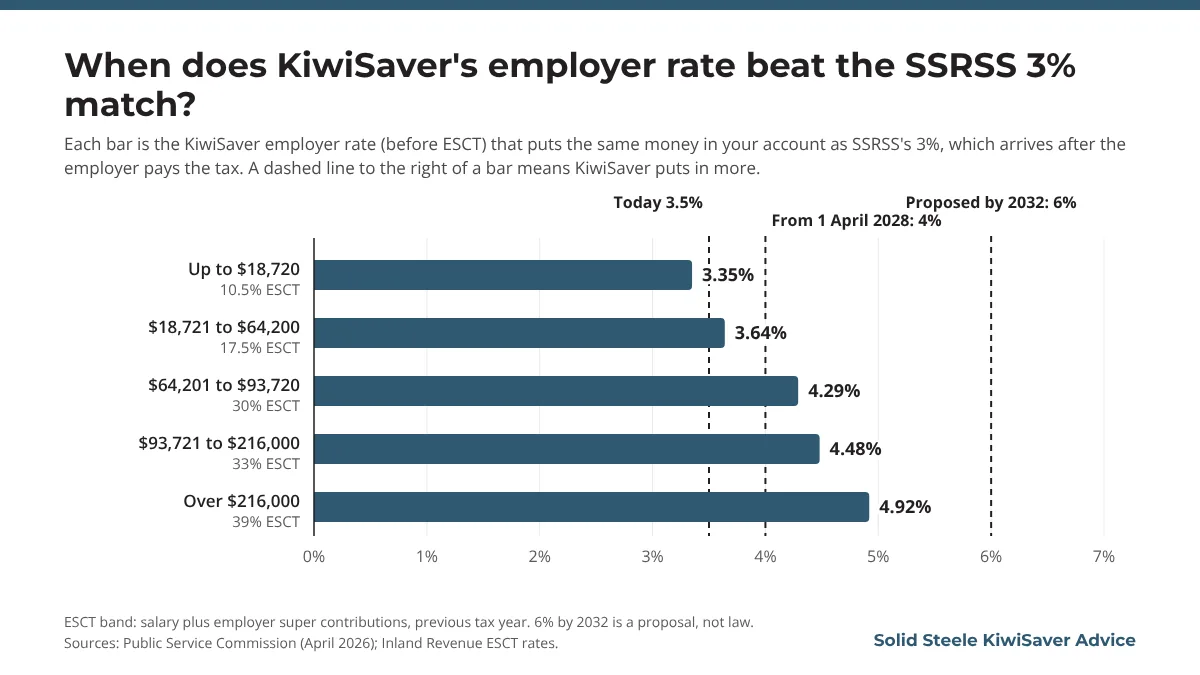
So the question becomes: at what KiwiSaver employer rate does the after-tax amount match the SSRSS's 3%? Because KiwiSaver's rate is taxed and the SSRSS's is not, the answer depends on your ESCT rate, which is set by your salary plus your employer's super contributions in the previous tax year.
| Salary plus employer contributions | ESCT rate | Break-even KiwiSaver rate | At 3.5% (today) | At 4% (April 2028) | At 6% (proposed) |
|---|---|---|---|---|---|
| Up to $18,720 | 10.5% | 3.35% | KiwiSaver higher | KiwiSaver higher | KiwiSaver higher |
| $18,721 to $64,200 | 17.5% | 3.64% | SSRSS higher | KiwiSaver higher | KiwiSaver higher |
| $64,201 to $93,720 | 30% | 4.29% | SSRSS higher | SSRSS higher | KiwiSaver higher |
| $93,721 to $216,000 | 33% | 4.48% | SSRSS higher | SSRSS higher | KiwiSaver higher |
| Over $216,000 | 39% | 4.92% | SSRSS higher | SSRSS higher | KiwiSaver higher |
Scroll the table sideways to see every column.
Read across your own row. For most members on teacher or public service salaries, the 2028 rise to 4% does not close the gap on its own. It narrows it. For members earning up to about $64,200, the 4% rate tips the employer money the other way. And if the employer rate ever reaches 4.5% or more, KiwiSaver puts in more employer money for almost everyone.
Here is what that looks like in dollars, on two salaries. These figures are the employer money reaching your account each year.
| Salary (ESCT rate) | SSRSS 3% | KiwiSaver 3.5% | KiwiSaver 4% | KiwiSaver 6% |
|---|---|---|---|---|
| $60,000 (17.5%) | $1,800 | $1,733 | $1,980 | $2,970 |
| $100,000 (33%) | $3,000 | $2,345 | $2,680 | $4,020 |
Scroll the table sideways to see every column.
Two things are easy to miss here.
First, the switch can happen without a transfer. Under the SSRSS rules, if you contribute to KiwiSaver from your pay and KiwiSaver's compulsory employer rate is the higher of the two before tax, your SSRSS employer contributions stop, your regular SSRSS contributions stop, and KiwiSaver employer contributions start instead. Your existing SSRSS balance stays where it is. So "where should future employer money go?" and "should I move my existing balance?" are two separate questions, with potentially different answers.
Second, a higher KiwiSaver rate usually means a higher rate from you too. Under today's rules, your minimum KiwiSaver contribution rises alongside the employer's. More employer money is real, but so is the smaller take home pay that may come with it.
Fees: the quiet variable
The employer advantage is a fixed dollar amount each year. Fees are a percentage of your whole balance, every year. That means the bigger your balance, the more a fee difference matters, and it can outweigh the employer advantage.
In some cases SSRSS fees compare well with KiwiSaver, particularly on the index-style funds, but not always. The same manager's fund can cost more inside the SSRSS than in that manager's own KiwiSaver scheme, so check your actual numbers rather than assuming.
A rough way to test it: divide the yearly employer advantage by the fee difference. On a $100,000 salary from April 2028, the SSRSS puts in $320 a year more than KiwiSaver at 4%. A fee difference of 0.5% a year costs the same $320 on a balance of $64,000. Above that balance, in that example, the fee difference would outweigh the employer advantage. Below it, it would not. Run the same test the other way if your SSRSS fees are lower than the KiwiSaver scheme you are comparing with.
That test ignores access, working past 65 and everything else on the list above, so treat it as one input, not the answer. But it does show why you need your actual fee numbers. Ask your SSRSS provider for the full fee schedule that applies to SSRSS members: the fund fee, any administration fee and any fixed member fee. Then compare it with the total annual fund charge of the KiwiSaver fund you have in mind, which you can look up in my KiwiSaver fund directory.
Questions to ask before you decide
- Which SSRSS provider am I with, and what is my balance split between my contributions, my employer's and any voluntary money?
- What is my ESCT rate, and is it likely to change?
- What are my provider's total fees for SSRSS members, including fixed fees, on the fund I am in or would choose?
- Is the fund I want available on my provider's SSRSS menu?
- Might I need some of this money before 65?
- Do I plan to keep working past 65?
- Am I contributing to KiwiSaver from my pay, or directly? (This decides whether the employer switch can happen automatically.)
- How much of my income sits outside my gross base salary?
My honest take
There is no single right answer to SSRSS or KiwiSaver, and I would be wary of anyone who gives you one without seeing your numbers. The scheme rules are fixed. Your salary, your tax band, your balance, your provider's fees and your plans for your sixties are not, and they are what decide it.
What I would say is this. The SSRSS is a closed door that only opens one way, so it is worth understanding before you walk through it. And the maths is going to keep moving: the 2028 rise is already law, and if the employer rate heads towards 6% after the election, it is worth running the numbers again rather than relying on what was true when you joined.
If you want to talk through the KiwiSaver side of that comparison, sessions with me are free and there is no obligation to act on anything.
Simple Steps. Solid Results.
This article is general information only and is not personalised financial advice. It reflects the SSRSS rules and KiwiSaver legislation as at October 2026, both of which can change.
Sources and further reading
The scheme rules come from the Public Service Commission. Check the current versions before you act:
- Public Service Commission - Guide: State Sector Retirement Savings Scheme - the two providers, the rule that members cannot change provider, the $100,000 worked example and the statement that the SSRSS rate will not rise in line with KiwiSaver.
- Public Service Commission - SSRSS - the Comparison of SSRSS and KiwiSaver (April 2026) and the SSRSS Members' Guide, including the closing dates, contribution rules, access rules and the employer contribution switching test.
- Inland Revenue - employer superannuation contribution tax - ESCT rates and how the threshold is worked out.
- Inland Revenue - KiwiSaver - contribution rates, the 2028 increase and the government contribution.
- SuperLife - SSRSS and AMP - New Zealand Retirement Trust - each provider's own information, funds and fees.
- Look up the fees and returns of any KiwiSaver fund in my KiwiSaver fund directory.
Want help with the KiwiSaver side of the comparison?
A free 30-40 minute session with Cam. No obligation. Online anywhere in NZ or in person across Canterbury.
Book a free session